
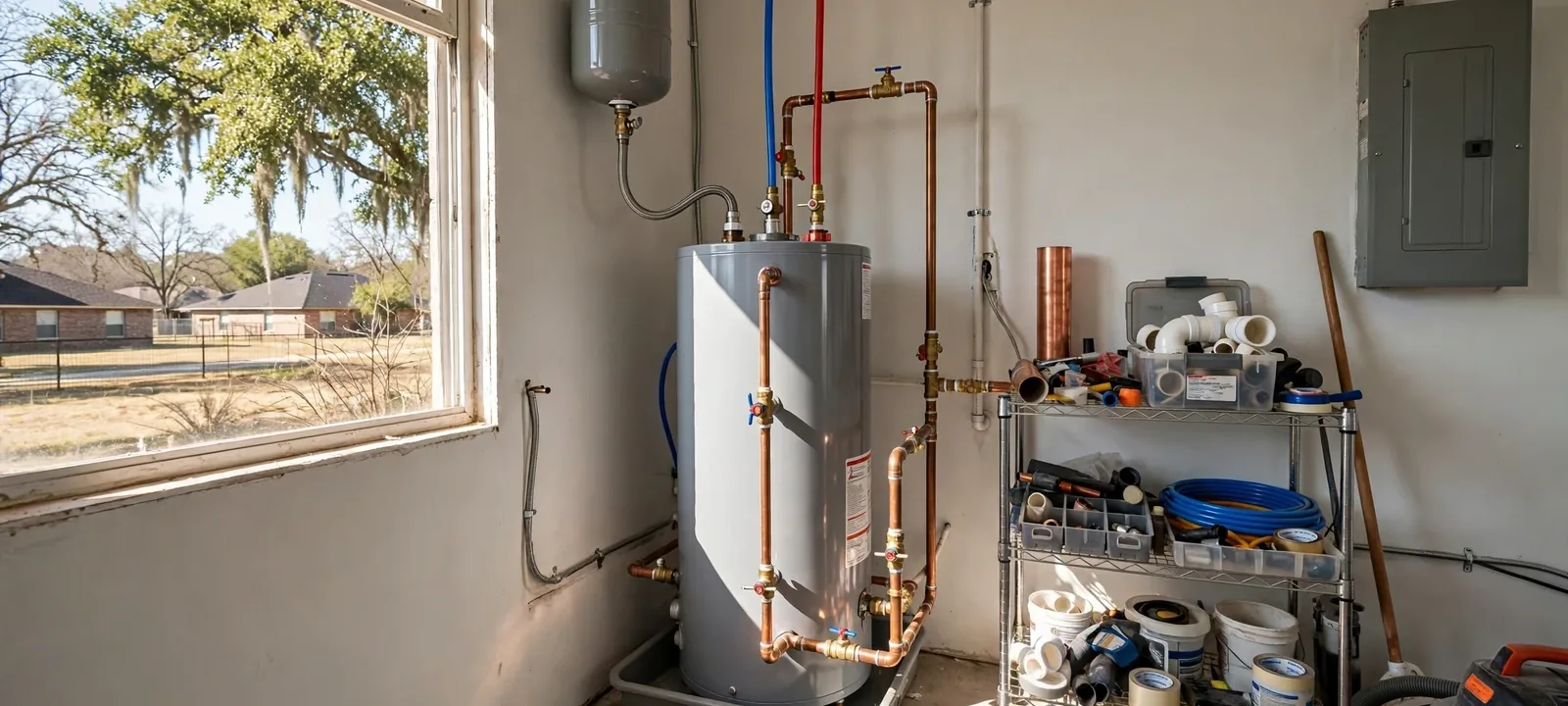
When a failed tank is an emergency
A tank that has rusted through can release fifty gallons or more onto a floor. If that is happening, call right away. We take emergency calls 24/7, and same-day replacement appointments are available when the schedule allows.
- Shut the cold water supply valve above the tank.
- Turn off the breaker or set the gas control to off.
- Open a hot tap upstairs to relieve pressure and drain slowly into a bucket or floor drain.
- Lift stored items off the floor, and shut off power to wet areas if water reached outlets.
- Call (609) 547-1417 and give the fuel type, tank size on the label and where the heater sits.
Gas smell
If you smell gas, leave the home first. Call the gas utility or 911 from outside, then call us when it is clear.
Replacement decision: what to weigh
| Choice | Good fit when | Watch for |
|---|---|---|
| Same fuel, same size tank | You want the quickest swap and your family size has not changed | Old venting or fittings may need updating |
| Gas to electric | Venting is a problem or gas service is limited | Needs a proper circuit in the panel |
| Electric to gas | Gas is already in the home and capacity matters | Needs a vent route and gas piping |
| Tank to tankless | You have the gas supply and space for a larger project | See the tankless water heater page |
Planned changes of location or fuel are covered under installation.
If the tank is not leaking and might be fixable, read about water heater repair first. For moves to a new spot or a new type, see water heater installation.
Safety checklist before the swap
Gas smell: leave and call 911 or the gas utility. Leaking tank: shut the cold supply, turn the breaker or gas control off. Replacement units are built to the ANSI Z21.10.1 standard for gas models, and installation falls under New Jersey's Uniform Construction Code plumbing subcode (N.J.A.C. 5:23-3.15), with a permit and inspection as the norm.
Signs the tank is past saving
- Water pooling under the tank bodyA rusted shell cannot be patched, and replacement is the only fix.
- Rust-colored hot waterOften the inner lining is failing and the anode rod is gone.
- Repeated repairs in a yearEach bill adds up and the next part to fail is rarely far behind.
- Loud rumbling that flushing does not cureHeavy sediment can bake onto the bottom of an old tank.
- Tank old enough to have rust on the topCheck the date on the label. Most tanks wear out after a decade or so.
How the swap goes
- SizingCapacity and recovery are matched to the number of people and the fixtures you use.
- Drain and disconnectThe old tank is drained, disconnected and carried out.
- Set and connectThe new tank is set on a pan or stand as needed, with a new relief valve and discharge pipe.
- Venting and gas checkOn gas units the vent and connections are checked and leak tested.
- Fire up and testWe flush air from the lines, confirm hot water at the tap and check for leaks.
Permits and inspections for water heater work go through the municipal construction office under New Jersey's Uniform Construction Code. Ask the technician what applies to your job.
Manchester homes and tank placement
Median home age here is about 1979, so many heaters sit in original basement corners or narrow closets with old venting and shutoff valves. A new tank may need a new pan, a new vent connector or updated shutoffs. Tell dispatch about the location up front and the technician can bring the right fittings.
In Crestwood Village, Leisure Village West and other active-adult areas, the heater often sits in a utility closet with a door. Clearing the area before the visit saves time. Stairs and tight corners also affect how a tank is carried out.
Water at about 3 to 6 grains per gallon is soft to moderately soft, so scale is mild. Iron in parts of the western system can still build sediment. A yearly flush after the swap helps the new tank last.
Want a plan and a clear price for a new tank? Call (609) 547-1417.
What drives the replacement price
- Tank size and typeLarger tanks and high-efficiency models cost more than a basic 40 gallon.
- Fuel and ventingGas units need vent work and a gas connection. Electric units need the right circuit.
- Code itemsRelief valve, discharge pipe, expansion tank and shutoffs may need updating.
- Access and haul-awayStairs, tight closets and long carries add time.
- Emergency timingAn after-hours call may cost more than a scheduled day, and you hear the price first.
Frequently asked questions
Yes. We take calls 24/7. If the tank is leaking, shut off the cold water supply and the power or gas, then call (609) 547-1417. Same-day replacement is available when schedules and parts allow, and you hear a clear price before work starts.
A leak from the tank body means replacement. No heat with a dry, sound tank is often a part. A technician can confirm on site.
Most same-type swaps take a few hours, but venting, access and code updates can add time.
Often yes, if the panel can handle a new circuit and a vent is not needed. The technician will check the panel.
It depends on how many people and fixtures. A larger family or a big soaking tub calls for more capacity.
If the tank is past a decade and rusting, planning the swap on your schedule beats a basement flood.
Leave, then call the gas utility or 911. Do not operate switches. We will come once it is safe.