
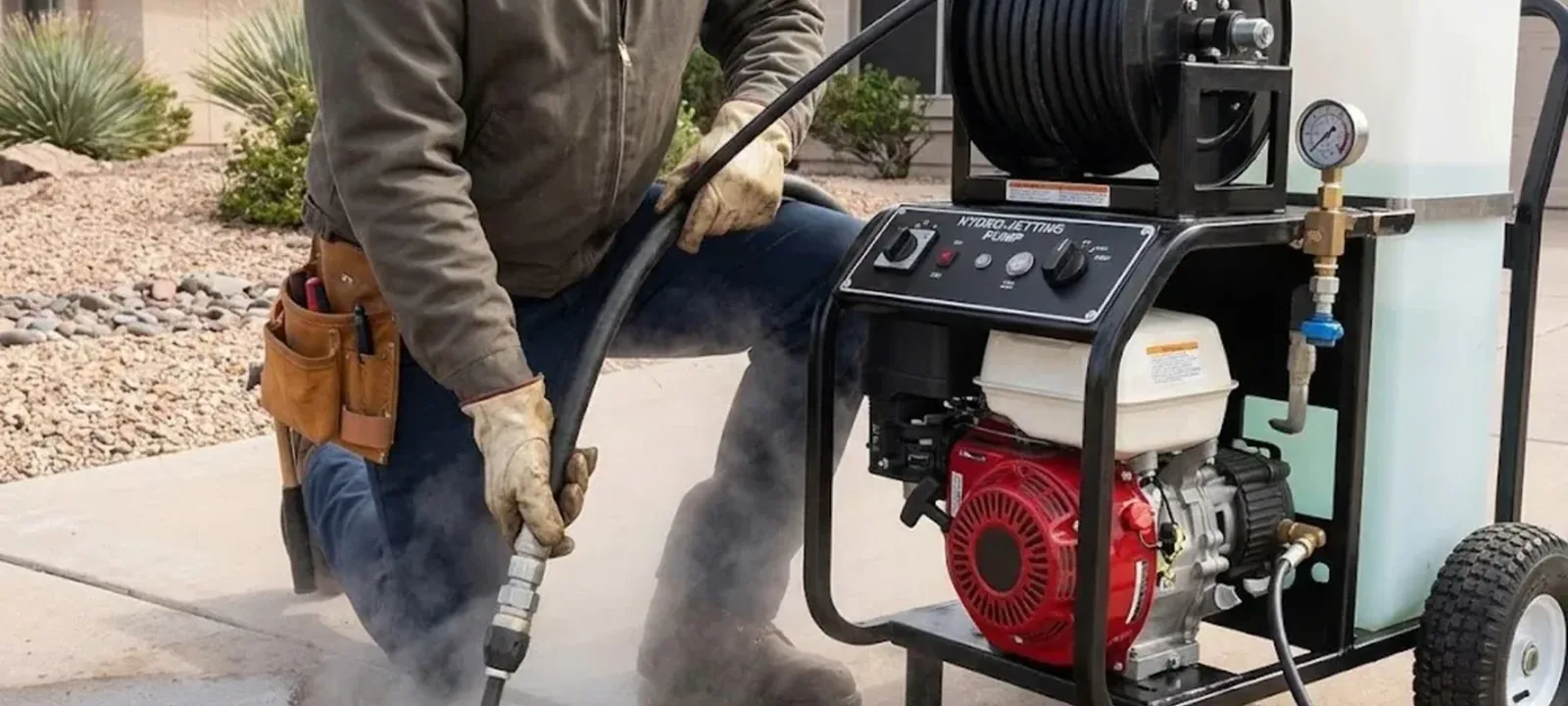
Drain keeps backing up after cabling? Here is what jetting does
Hydro jetting sends water through a flexible hose at high pressure, with a nozzle that fires jets forward and backward. The spray cuts grease, packed sludge, scale and fine roots off the pipe wall instead of just poking a hole through the middle. The result is a pipe that is close to its full inside diameter again.
That is why people call about it after a cable has failed once or twice. The symptoms are familiar: a drain that clears and slows again within weeks, a main line that backs up every few months, or a kitchen line that smells even when it drains. We take urgent jetting calls 24/7, and same-day visits are available when the schedule allows.
Cabling versus jetting
| Question | Cable (snake) | Hydro jetting |
|---|---|---|
| What it does | Punches or cuts through the blockage | Washes the full pipe wall |
| Grease on the walls | Often left behind | Removed |
| Roots | Cuts the main mass | Cuts fine roots and clears the debris |
| Cracked or collapsed pipe | Can be used with care | Not advised without a camera look first |
| Typical use | Single, fresh clog | Repeat clogs, grease, long lines |
A technician can tell you which fits after hearing the history. A camera look settles it when the line is old.
Where the code applies
Jetting clears pipe and does not change it, so no permit is usually involved. Repairs that follow meet the code standard in New Jersey's Uniform Construction Code plumbing subcode (N.J.A.C. 5:23-3.15), and camera findings are often described with NASSCO PACP coding.
Signs jetting may be the better fix
- Repeat clogsThe same line has been cleared more than once in a year.
- Slow flow all the timeWater drains, but never quickly, even after a cable visit.
- Grease smellA rotten odor from a kitchen line often means a thick fat layer inside the pipe.
- Roots in the mainA camera or a past cabling returned root fragments.
- Main line backs up with heavy useLaundry day or a full house of showers pushes the line past its capacity.
What to do while you wait for a jetting visit
- Stop using water in the house, especially the washer and dishwasher.
- Keep people and pets away from any standing wastewater.
- Note which fixtures back up and in what order.
- Find the main cleanout if you can, usually a capped pipe in the basement, crawl space or yard.
- Call (609) 547-1417 and describe the history of past cabling.
Do not try to push the clog with chemicals or a rented jetter. Pressure applied to a damaged pipe can make it worse.
How a jetting visit goes
- Talk through the historyThe tech asks about past clogs, pipe age and which fixtures are affected.
- Locate accessA cleanout is ideal. Without one, a toilet may be pulled or another opening used.
- Camera check when neededIf the pipe is old or the cause is unclear, a camera confirms the pipe can take the pressure.
- Jet the lineThe nozzle is fed through the line in passes, then pulled back while cleaning.
- Test the flowWater is run through the fixtures to confirm the line drains.
Older pipes in Manchester Township: when jetting is and is not right
About half of the township's homes were built before 1980, and the median home dates to 1979. Cast iron lines from that period often have a rough, scaled interior, and jetting cleans that scale well. But a clay or old fiber line with a broken joint or a bellied low spot may not hold pressure, and a camera look first protects the pipe.
Tree roots entering a joint are common in sandy Pinelands soil, where roots reach toward a sewer line for moisture. Jetting can clear root growth, but the roots return if the joint stays open. If the camera shows a cracked joint, the honest answer may be a sewer line repair after the jet. Soft water means scale is a small player here, so grease and roots are the usual targets.
What affects the price of jetting
- Line length and sizeA short branch is faster than a long run to the street.
- SeverityA thick grease layer takes more passes than light buildup.
- AccessA proper cleanout saves time. Pulling a toilet adds labor.
- Camera workA before and after scope adds a step, and it also shows whether the fix held.
- Hour of the callNight and weekend work is priced for the hour, and you hear that up front.
Want to know if jetting suits your line? Call and describe what has been done so far.
Landlords, restaurants and shops
Rental buildings with shared stacks and small food businesses with grease lines are the common repeat customers. If you manage property, ask for a jetting visit on a schedule that fits your problem, rather than waiting for the next emergency. Grease traps and interceptors have their own cleaning needs, so tell dispatch what you have. The same crews serve Toms River and Berkeley Township if your shop sits just outside the township.
Ready to ask about jetting? Call with your drain history and get a price first.
Frequently asked questions
Yes. The line is open 24/7. If a main line is backing up into the house at night, call, describe the history and you will get a clear price before work starts, with a same-day visit when the schedule allows.
A slow drain without an obvious blockage is often a pipe lined with grease or scale. A cable may open it briefly, but jetting restores the full bore.
Jetting is safe on sound pipe. It is not advised on cracked, collapsed or badly offset pipe, which is why a camera look comes first when the line is old.
It depends. For a fresh, single clog a cable is enough. For repeat clogs, grease or roots, jetting cleans more of the pipe.
Jetting can clear a line leading to a septic tank. It does not fix a full tank or a failed drain field, so tell us which system you have.
Only as often as the cause requires. Some lines need it once, others on a schedule for grease. A camera look after the first jet helps set the interval.
Keep the invoice and any camera notes. If the cause was misuse by tenants or a pipe defect, the paperwork supports whichever case applies.