
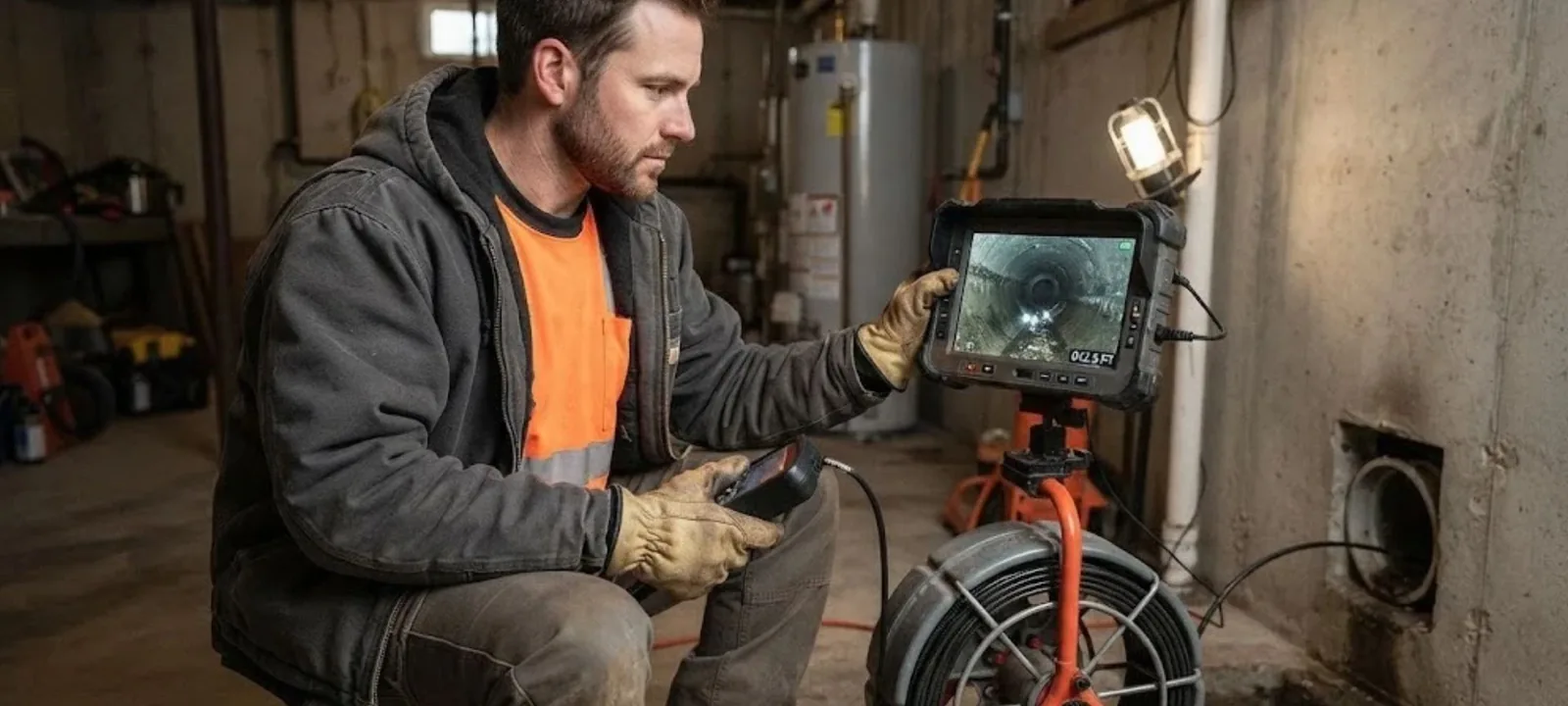
Who needs a camera inspection
A camera inspection answers a simple question: what is wrong with this pipe, and where? It is the step that turns guesswork into a plan, and it is useful in four situations.
- You are buying a home built decades ago and want to know the sewer lateral's condition.
- The main line has backed up more than once and cabling has not held.
- You have a sunken yard spot, a sewage odor or unexplained wet ground.
- A repair is planned and you want to confirm which method suits the pipe.
This is usually a planned visit, though same-day appointments are available when the schedule allows. If sewage is backing up right now, that is an emergency, and the sewer line cleaning page covers what to do first.
What the camera can show
- Pipe materialCast iron, clay, fiber, plastic. Each ages and fails differently.
- Cracks and broken jointsWhere a pipe has split or a joint has opened.
- Root intrusionFine roots or a dense mass pushing into the line.
- Offsets and belliesLow spots that hold water and catch debris.
- Scale and buildupRough pipe walls that catch grease and paper.
- Collapse or obstructionA section that has caved or been blocked by debris.
How inspection results are described
Camera findings are commonly coded with the NASSCO Pipeline Assessment Certification Program (PACP) scheme, which gives a repeatable standard way to describe cracks, roots and offsets. Repairs that follow fall under New Jersey's Uniform Construction Code plumbing subcode (N.J.A.C. 5:23-3.15).
Getting ready for the visit
Find the cleanout
Tell the tech where it is, or say you do not have one.
Clear access
Move stored items from the basement or crawl space near the line.
Share the history
Past backups, repairs, and any cabling visits help interpret what the camera sees.
Know your system
Say whether the home is on sewer or septic.
Plan to watch
Ask the tech to explain what is on the screen as it happens.
The camera head is on a flexible cable and moves through the line while a locator on the surface marks where problems sit. The tech can mark depth and location, which helps if a dig is needed later.
What the footage means: next steps by finding
| What the camera finds | Typical next step | Honest note |
|---|---|---|
| Clean pipe, no defects | Nothing needed beyond routine care | Good news for a buyer |
| Grease or scale buildup | Jetting to clean the walls | May return if the pipe is rough |
| Roots in joints | Root cutting, then joint repair | Cutting alone is temporary |
| Small cracks, pipe sound overall | Trenchless lining may suit | Lining needs enough pipe shape and flow path |
| Collapse, major offset or bellied pipe | Spot dig or replacement | Lining does not fix the shape |
Lining is not right for every pipe. The camera is how you find out which situation you have.
If you are selling or buying, get a copy of the video. It documents the line at a moment in time and supports negotiation on repair costs.
Why a scope matters for homes in this township
About 52 percent of Manchester Township homes were built before 1980, and the median build year is 1979. Laterals from that period can be cast iron, clay or bituminous fiber, and they are now close to or beyond the age where problems show up. A buyer in Whiting, Pine Lake Park or one of the older communities gets real value from knowing the pipe type before closing.
Sandy Pinelands soil lets tree roots travel toward sewer joints, so a lot with mature trees is a candidate for a scope even without symptoms. Not every home is on public sewer, so check first. If you have a septic system, ask which parts the camera can reach. Tank and field inspection is a different service.
For work that follows, plumbing permits and inspections go through the municipal construction office. Having the footage in hand makes that conversation easier.
What an inspection costs: factors
- Access pointA cleanout makes it quick. Pulling a toilet adds time.
- Line lengthLonger runs take more time and cable.
- BlockageIf the line is blocked, it may need cleaning before the camera can pass.
- LocatingMarking the depth and position on the surface is an extra step.
- Report and videoA recorded copy for a closing or insurer is part of the plan, so ask what you will receive.
Want a price for a camera visit? Call and tell dispatch the house age and reason.
Buyers, sellers and landlords
Buyers can ask the seller for a scope or order one during the inspection period. Sellers sometimes scope first to avoid surprises. Landlords with several older units gain by scoping the shared line before a failure. Whatever your role, keep the video and written notes together with your closing or maintenance file. Buyers closing on homes in Lakewood or Lakehurst can book the same visit.
Want a camera visit on the calendar? Call and name the reason.
Frequently asked questions
Simple runs are usually quick, but length, access and any cleaning needed first change that. Ask dispatch when you book.
Ask when you book. A recording is useful for buyers, sellers, insurers and any later repair.
Usually it is planned, with same-day appointments when available. If sewage is backing up, call as an emergency and the line gets cleared first.
No. It looks inside the drain and sewer pipe. Supply leaks are a different diagnosis, covered by leak detection.
A camera is gentle compared with cleaning tools. If the line is blocked, cleaning may be needed first, and a fragile pipe is handled with care.
Check your township records or utility bill. If you are unsure, tell dispatch before the visit.
For homes built before 1980, many buyers choose to. It shows pipe type and condition before you commit.