
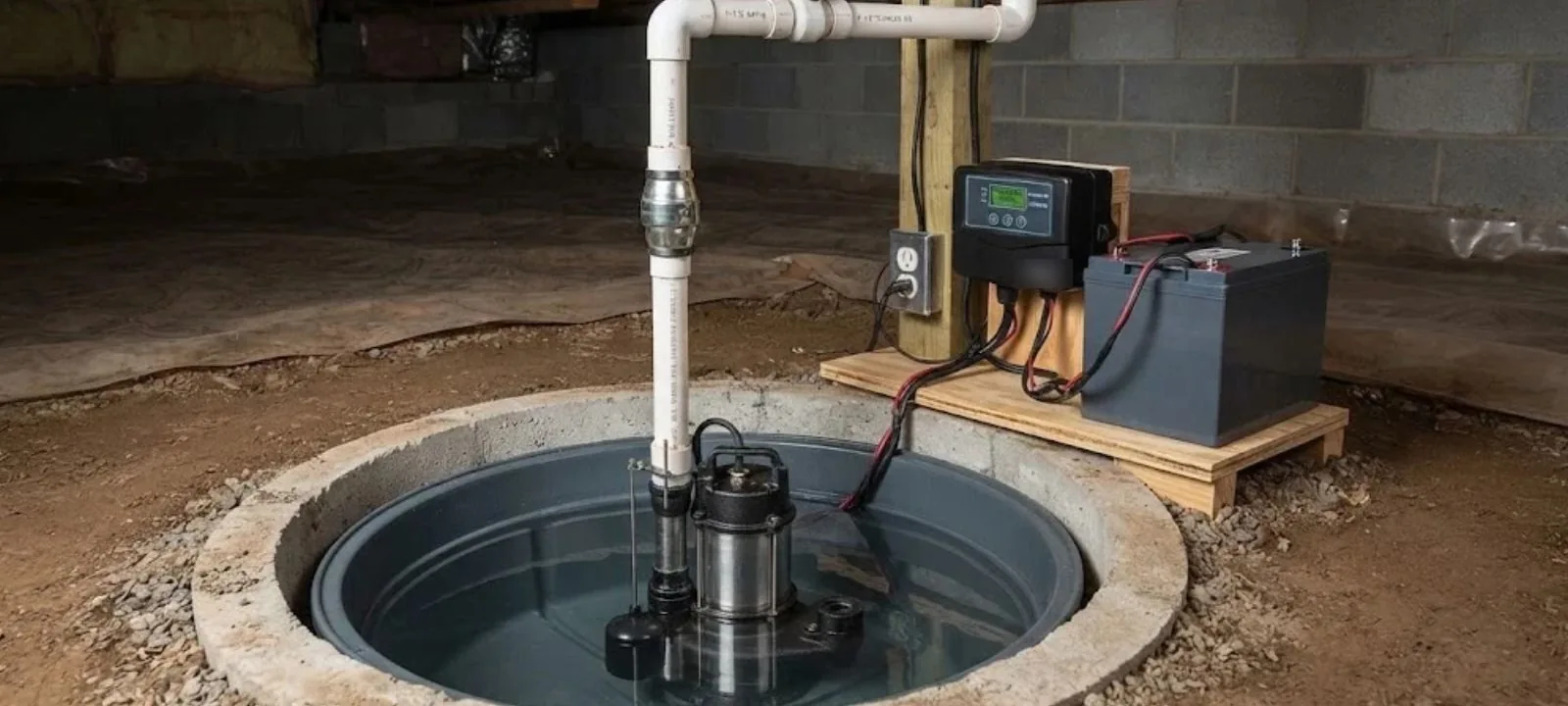
The short answer: what goes into a crawl space sump
Installing a sump pump in a crawl space means digging a small pit at the lowest spot, setting a basin in it, dropping in a pump, and running a discharge pipe to the outdoors. A check valve on that pipe stops water from falling back into the pit after each cycle. A dedicated electrical outlet powers the pump, and a float switch tells it when to run.
The work sounds simple, but a crawl space makes everything harder. If a pump is already there and failing, sump pump repair may cost less than a new install. Headroom is tight, the soil is damp, and a vapor barrier may cover the ground. Most of the labor is digging, fitting and sealing in a cramped space, not the pump itself.
If water is standing in your crawl space right now, call (609) 547-1417. Dispatch is open 24/7 and you hear the price before work starts.
Before you buy a pump: is a sump really the answer?
A sump pump removes water that has already collected. It does not stop water from entering. If the real problem is a downspout dumping beside the foundation or a grade that slopes toward the house, fix that first and the pit may never fill.
- Standing water after rainPuddles or a damp film on the crawl space floor that stays for days.
- Musty smell upstairsMoisture rising from below shows up as odor in closets and floors.
- Soft or stained floor joistsDark staining or a spongy feel near the sill points to repeated wetting.
- Efflorescence on blockWhite powder on foundation walls is a sign water moves through them.
Walk the outside of the house during a rain. Look for downspouts that end within a few feet of the wall and for low spots where water pools. Those are low-cost fixes with a splash block or a downspout extension, and they lower the load on any pump you do install.
How the install goes, step by step
- Find the low pointThe installer checks where water collects and where the discharge can exit the house.
- Cut and dig the pitA section of vapor barrier is lifted and a hole is dug a little deeper than the basin.
- Set the basinThe basin sits level on a bed of gravel, with its rim just above or flush with the floor.
- Place the pump and floatThe pump stands on a firm base with the float free to rise and fall without touching the walls.
- Add the check valve and dischargePipe runs up and out through the rim joist, with a valve to stop backflow.
- Seal and testThe vapor barrier is sealed back to the basin lid and the pit is filled with water to confirm it cycles.
Expect the installer to test the pump more than once. A float that sticks against the basin wall is the most common cause of a pump that never turns on, and it is easy to catch during the test.
Pump types and what changes between them
| Type | Where it fits | Main trade-off |
|---|---|---|
| Submersible | Most crawl space pits, quiet and sealed | Harder to reach for service once buried in the pit |
| Pedestal | Deep, narrow pits with a little headroom | Louder and the motor is exposed to crawl space humidity |
| Battery backup | Added beside the main pump | Needs a charged battery and an occasional test |
| Water-powered backup | Homes on municipal water pressure | Runs only with water pressure and uses extra water |
Right sizing depends on how much water enters and how high it must be lifted. Ask for the reasoning, not just a model name.
Discharge: where the water is allowed to go
The discharge line should end outdoors, well away from the foundation, and drain downhill. Ending it too close to the house sends the same water straight back to the pit. In winter, a line that ends at ground level can freeze shut, so many installs leave a way for water to escape.
Do not tie a sump into the sanitary sewer
Sump water belongs outside, not in the home's drain or sewer line. Many municipalities prohibit it, and it can overload sewer systems during storms. Ask the municipal construction office what applies at your address.
Because a pump needs power, the outlet matters too. It should be on its own circuit, ideally with GFCI protection, and placed where a cord never has to cross standing water. Electrical work may need its own permit and inspection, so ask before you start.
What you can do yourself and when to call
- Do: clear leaves from gutters, extend downspouts, and regrade low spots along the foundation.
- Do: pour a bucket of water in the pit each season and confirm the pump starts and shuts off.
- Do: write down where water first shows up and after how much rain.
- Call: water is within a few inches of the electrical panel, outlets or a furnace.
- Call: the pump hums but does not move water, or runs without stopping.
- Call: you need a new pit cut, a discharge line run, or a new outlet added.
Safety in a wet crawl space
Never enter a crawl space with standing water if any wiring or equipment sits near it. Turn off power at the panel first, or leave it to a pro. Crawl spaces can also hold poor air and sharp debris.
Some crawl space water problems need more than a pump, such as sealing walls or controlling groundwater at the footing. That is the territory of basement waterproofing, and a good installer will tell you honestly which one you need.
Not sure whether the water is a pump problem or a drainage problem? Call and describe what you see.
Manchester Township notes for a crawl space sump
Manchester sits in the New Jersey Pinelands, where sandy soil drains quickly. That is why many crawl spaces here stay dry until a heavy storm or a high-water stretch near the lakes and streams. A pump in this setting often sees short, intense bursts of work, so a reliable float and a tested backup matter more than a huge motor.
About half of the township's roughly 26,400 homes were built before 1980, and the median home dates to 1979. Many of those houses have older crawl space walls, original wiring and drain lines that run near the pit. Have the installer check the outlet and the path of any nearby drain pipe before digging.
Permits and inspections for plumbing and electrical work go through the municipal construction office under New Jersey's Uniform Construction Code. A quick call before the job tells you what paperwork applies. Neighbors in Whiting, Pine Lake Park and the older sections near Route 70 can all ask the same office, since the rules follow the township, not the street. If your property is across the line in Toms River or Jackson, a different construction office applies.
Our water also matters a little. The Manchester Township Water Utility serves water that is soft to moderately soft, but iron can reach up to about 1 ppm in parts of the western system. Iron-rich discharge can leave orange stains on a pump and its pipe, so wipe and inspect them at your seasonal test.
Frequently asked questions
Most installs take a few hours to most of a day, depending on how hard the digging is, how far the discharge must run and whether electrical work is needed. Call (609) 547-1417 to have the job described to you with a price before work starts.
A backup is worth considering where storms cause power outages, since a pump cannot run without power. A battery unit or water-powered unit sits beside the main pump and takes over when it fails.
Outdoors, well away from the foundation, and on ground that slopes downhill. It should not connect to the sanitary sewer or drain onto a neighbor's lot.
Not always. A pump removes pooled water, but gutters, grading and a vapor barrier handle the moisture that enters in the first place. A good install often combines the pump with these other fixes.
Permit rules vary with the work involved, especially if wiring or new piping is added. Ask the Manchester Township construction office before work begins, since it handles permits and inspections under the state's Uniform Construction Code.
Not without a backup. A standard pump runs on household power, so a battery or water-powered backup is the only way to keep pumping when the lights go out. If the pump already runs and water is still rising, call (609) 547-1417.